#005 - Sigmoid Prominent (Clostera albosigma)
I don’t often see this moth during the day. When I do, it’s pressed against the pale bark of a willow or young cottonwood, with wings folded tightly and body angled upward, as if it grew there.
At first, it disappears.
Then the mark appears. Near the edge of the forewing, there is a clear white S-shaped line within a rust-colored patch. That curve gives the moth its name. Most prominent moths fade completely into bark and leaf litter. This one leaves a small signature.
The caterpillars feed only on willows and poplars—trees that grow in wet, shifting ground. Trees that lean over creeks and root into gravel. In areas where the soil is still moving, these trees are often the first to take hold.
The moth is following them.
I notice it mostly along creek banks and wetland edges. The ground there remains cool longer into the day. Willow roots braid into the bank. Cottonwood leaves turn their pale undersides to the wind. It is a place of steady growth and consistent feeding.
Across much of its range, it produces two generations each year. Floodwaters rise. Branches snap. New shoots push out again. The cycle continues. By late spring and into summer, there are caterpillars in the leaves, and birds moving through the canopy.
Warblers glean. Chickadees work methodically along the stems. What falls beneath the tree returns quietly to the soil.
Leaf into caterpillar.
Caterpillar into a bird.
Nothing wasted.
Clostera albosigma is easy to overlook. You might never notice it unless you pause along the bark of a willow and let your eyes adjust.
But if you're planting for creek health, native willows and poplars are worth the space. They aren't neat trees. They bend. They shed. They move with water.
And sometimes, against their pale trunks, a small white S remains there for a day, a brief mark showing that the edge is alive.
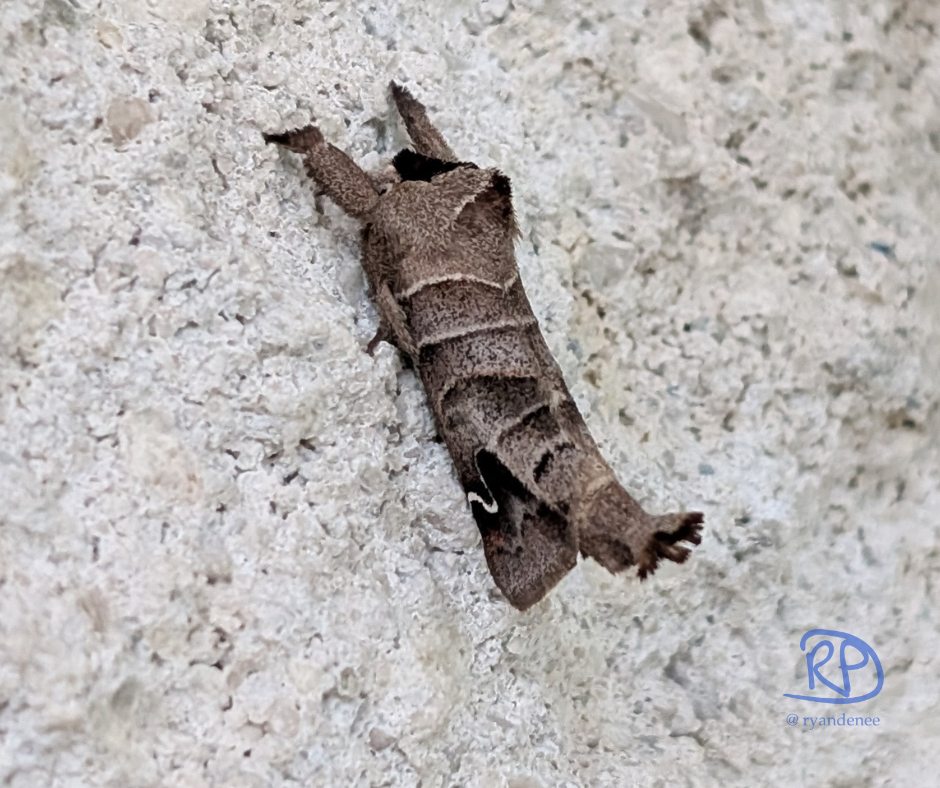
Sigmoid Prominent (Clostera albosigma)
